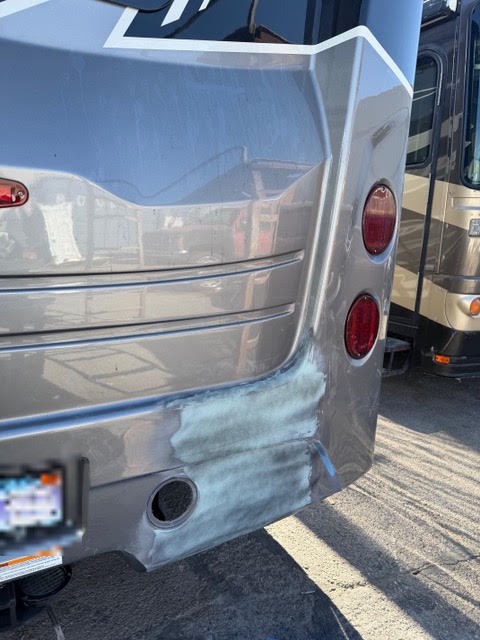
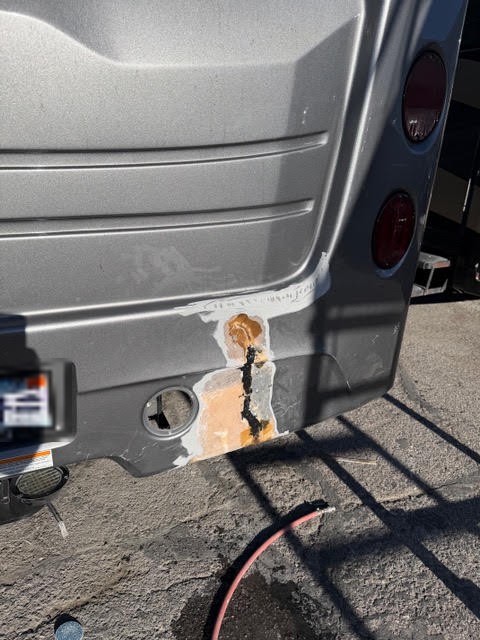
 Before
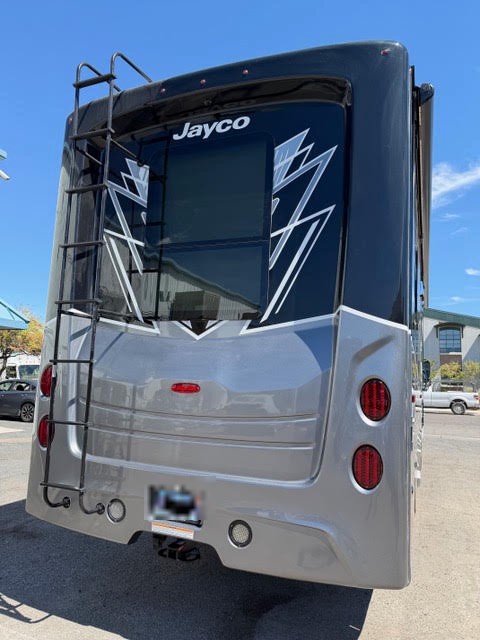
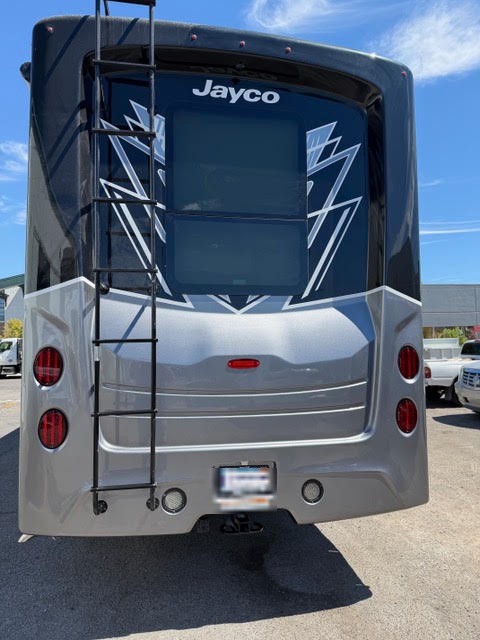 After
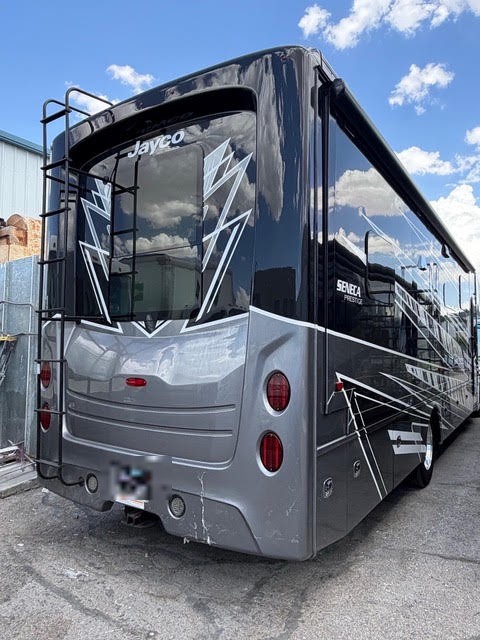
After
The compromised section removed and rebuilt in fiberglass — contours, body lines and lower rear profile back where the factory put them.
The owner of this 2026 Jayco Seneca Prestige 37M found us through Google and called about damage to the rear of his motorhome. He needed it repaired inside a limited window, so our technician and service writer inspected the damage together and put a plan on paper the same visit.
The inspection settled the important question early: this was not a surface repair. The fiberglass in the lower rear wall was compromised, and compromised composite cannot be filled and painted over — it has to come out. What it does not need is a whole new rear section, which on a current-model motorhome means a long parts wait and a much larger bill.
So the damaged portion of the lower rear wall was cut out. Removing the bad material left solid fiberglass to build against, and a clean edge to rebuild the missing area from. Our technician worked in the appropriate protective equipment throughout — fiberglass particles and dust are not something to be casual about.
The missing section was then rebuilt in multiple layers of fiberglass, each one laid to restore strength, shape and structural integrity rather than just fill the gap. With the material built up, the repair moved into shaping: fitting and working the section until it matched the motorhome’s original contours, curves and body lines. On a rear wall that wraps and steps the way this one does, that stage is detail work — the repair has to read as continuous surface, because there is no seam or gap to hide behind.
For reinforcement, custom aluminum sheets were fabricated and fitted behind the repaired area, then covered with additional fiberglass to lock the reconstruction in place. A motorhome rear wall carries a ladder, a hitch and years of road vibration; the backing is what keeps the repair from being a cosmetic fix.
Exterior bodywork followed. Automotive body filler refined the surface, then repeated cycles of shaping and sanding took out the imperfections until the panel was smooth and even. The area was sanded and refined a final time — fiberglass reconstruction and surrounding body lines properly restored — and prepared for primer and paint.
Fiberglass reconstruction, custom reinforcement fabrication, contour and body-line restoration, several stages of bodywork and detailed preparation: the result is a strong, correctly shaped repair, ready for refinishing and invisible once it is done.