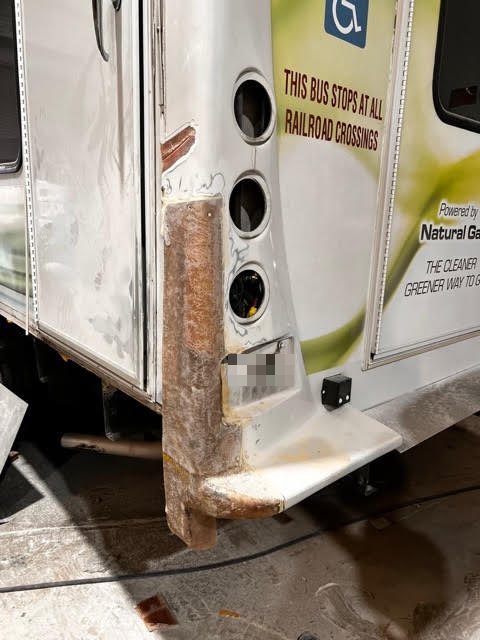
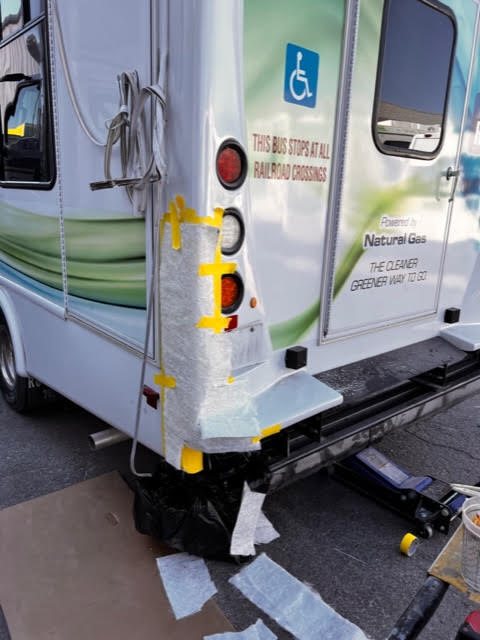
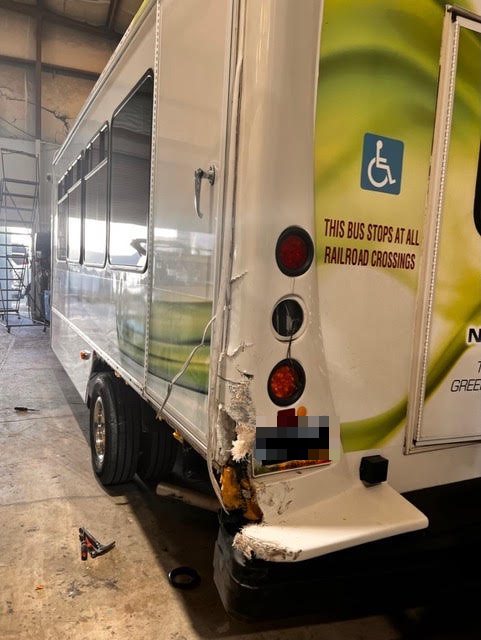
 Before
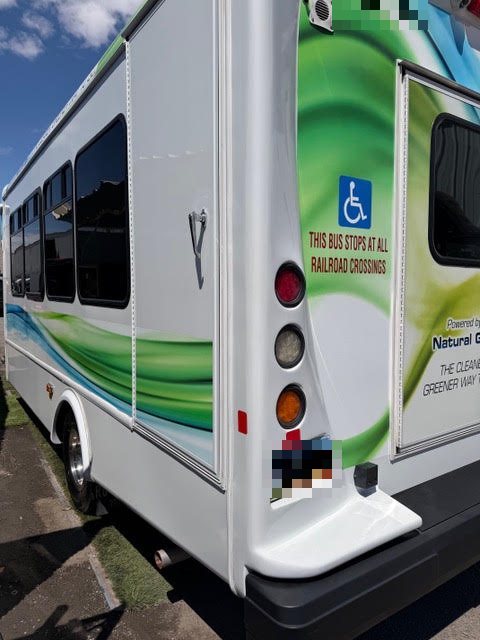 After
After
The rear corner rebuilt in fiberglass rather than replaced — factory body lines, taillight openings and graphics all restored.
This shuttle bus arrived with extensive impact damage to the right rear corner. The collision tore through the fiberglass body, destroyed the taillight mounting area, and distorted the body lines around the rear access door.
The obvious move is to replace the entire rear body section. It is also the expensive one, and on a fleet vehicle it means weeks waiting on a large composite panel that may not be available. Before quoting that, our technicians assessed whether the damaged fiberglass could be reconstructed instead — restoring OEM appearance and structural integrity while keeping as much of the factory body as possible.
It could. The damaged material was cut back to solid fiberglass, and the corner was rebuilt using professional composite repair techniques — recreating the original contours, restoring the taillight mounting area, and reinforcing the section for the loads a bus in daily commercial service actually sees.
That stage is where large fiberglass work is won or lost. The repaired section has to match the surrounding body exactly, because there is no panel gap to hide behind — the corner is one continuous surface wrapping from the side into the rear.
With the structure restored, the area was block sanded, primed, and fine-tuned until the factory body lines ran true. Then came the part that makes or breaks a wrapped commercial vehicle: precision color matching, blending into the surrounding panels, and rebuilding the factory graphics across the repair so the flowing green-and-blue livery lines up on both sides of the seam.
Lighting components and trim went back on, alignment was verified, and the bus returned to service. The finished repair is virtually undetectable.
Heavy commercial fiberglass is a different discipline from passenger collision work — different materials, different loads, different tolerances. It is also the reason we can restore vehicles other shops recommend replacing.